- Corporate Registry
How to Obtain a Certified Copy of a Corporate Registry Online: Introducing Convenient Viewing Services
Last Updated: August 4, 2025
With the Subcontract Act amendment approaching, many companies are being forced to review their business partners and improve their internal management systems.
The upcoming amendment, effective January 2026, is expected to have a wide-ranging impact on business operations, including the introduction of application criteria based on employee headcount, strengthened obligations for consultation regarding outsourcing terms, and restrictions on payment methods.
In particular, accurately determining which business partners fall under the scope of the law and organizing and managing information on these entities requires significant resources and specialized expertise.
This article outlines the key points of the amendment, the practical steps companies should take, and methods to reduce the operational burden of compliance.
Table of Contents
1Why Is the Subcontract Act Being Revised Now?
2Overview of the Amendment and Five Key Points to Watch
2-11. Terminology Change: From Subcontracting to Outsourcing and Entrustment
2-22. Expansion of Scope: Inclusion of Capital Plus Employee Headcount
2-33. Stricter Consultation Obligations: Unilateral Price Setting Is Prohibited
2-55. Expansion of Target Industries: The Transportation Industry Is Now Clearly Subject to Regulation
3Challenges Faced by Companies
3-1Challenge 1: Determining Target Companies Has Become Increasingly Complex
3-2Challenge 2: Inadequate Mechanisms for Identifying and Managing Target Entities
4Solution: How uSonar Can Support You
4-11. Data Preparation: Bulk Determination of Companies Subject to the Subcontract Act
4-22. Automated Data Maintenance
Recommended Articles
The Act against Delay in Payment of Subcontract Proceeds, Etc. (Subcontract Act) has been in operation for many years to rectify the power imbalance in business relationships between small-to-medium enterprises and large corporations.
It has been decided that the Subcontract Act will undergo significant revisions effective January 1, 2026. The purpose of these revisions is to address structural challenges and establish a more transparent trading environment that reflects current business realities.
This is driven by the following social changes:
Difficulty in passing on rising costs to prices
Increasing complexity of multi-layered supply chains
Growth in diverse forms of business outsourcing (e.g., manufacturing, service provision, and logistics operations)
The Decline in the Working Population and the Need for Transaction Efficiency
As the reality of business operations has expanded beyond what the term "subcontracting" can cover, a legal review has become essential.
The following is a summary of the key points to understand regarding this amendment.
The traditional terms "Parent Operator" and "Subcontractor" will be changed to
"Outsourcing Operator" and "SME Contractor."
This shift represents a move away from terminology based on power dynamics in transactions,
reflecting a commitment to equal and fair partnership.
While the application criteria were previously based primarily on capital,
the "number of employees" will now also serve as a criterion.
For example:
Manufacturing Industry: Companies with 300 or fewer employees qualify as small to medium-sized contractors.
Service and Transportation Industries: Companies with 100 or fewer employees are now eligible.
As a result, while more companies will fall under legal protection, the complexity of managing and assessing applicable companies will increase.
When a contractor requests a consultation regarding pricing or contract terms,
the commissioning party is obligated to respond in good faith and provide a reasonable explanation.
For example:
We would like to review unit prices in response to the recent surge in raw material costs.
We would like to negotiate additional costs for the increased man-hours resulting from process additions.
Ignoring or dismissing such requests in itself constitutes a violation of the law.
Instead of cash transfers, the following payment methods were widely used:
Promissory Notes
Electronically Recorded Monetary Claims
Factoring (Transfer Type), etc.
These methods are prohibited if they result in disadvantages to the contractor, such as inability to recover the full amount or delayed payment dates.
Transactions that were previously in a gray area, such as consignments from shippers to primary freight forwarders, are now clearly included in the scope.
Payment delays and unfair subcontracting practices in the logistics industry are now subject to corrective measures.
With the amendment of the Subcontract Act, companies will face the following challenges:
With the introduction of new standards that include the number of employees, accurate applicability assessments based on both capital and employee count are now required.
For example, even if a company's headquarters does not qualify, its branches or subsidiaries might fall under the scope of small and medium-sized subcontracting regulations, necessitating assessments at the transaction level.
Relying on individual knowledge or ad-hoc research is insufficient, significantly increasing the risk of violations due to misidentification, such as inappropriate pricing or failure to engage in required consultations.
Even if target companies are correctly identified, many organizations lack a centralized system to manage and update this information internally.
For instance, even if the legal department is aware of the assessment, this information may not be adequately communicated to sales teams, leading to cases where field staff inadvertently propose incorrect contract terms.
When relying on Excel or individual-based management methods, omissions and oversights are likely to occur, which can lead to legal compliance risks and require careful attention.
At uSonar Co., Ltd., which provides services centered on a corporate database,
we offer the following services to address these challenges.
The LBC (Corporate Database) provided by uSonar covers over 12.5 million corporate locations nationwide and maintains high-precision corporate attributes essential for Subcontract Act applicability assessments, such as capital, employee count, and head office/branch classifications.
By leveraging this data, it becomes possible to determine which companies are subject to the Subcontract Act and whether they fall under the category of consignor or consignee, objectively and consistently, without relying on individual expertise.
Furthermore, by integrating this with business card and client information scattered throughout your company, you can achieve normalization and data cleansing at the corporate level, thereby building a data foundation capable of supporting regulatory compliance.
Regulatory compliance is not a one-time task; a continuous management system is essential. Corporate information changes daily due to fluctuations in employee count, capital changes, company name changes, and M&A activity.
uSonar provides a mechanism to respond to these changes and maintain data in an up-to-date state through regular, automated updates.
Furthermore, it supports API integration with external tools such as CRM and Salesforce, enabling departments to reference the same information. This allows you to build a sustainable data management system while minimizing the risks of update omissions and redundant management.
While not directly related to the amendment of the Subcontract Act, the credit status and potential risk information of partner companies are critical decision-making factors when reviewing business partners or re-evaluating contracts.
uSonar provides integrated access to proprietary credit scores, negative news detection, anti-social force flags, and corporate group information, enabling immediate risk checks even at the initial stage of business negotiations.
This contributes not only to regulatory compliance but also to building relationships with sound business partners and reducing reputation risk.
| Phase | What You Can Do With uSonar |
|---|---|
| Preparation Before Amendment | Target Company Extraction, List Creation, and System Development |
| Operations After Revision | New Business Partner Screening / Re-negotiation Record Management |
| Ongoing Operations | Automatic List Updates, Credit Risk Monitoring, and Centralized Internal Management via SFA Integration |
The amendment to the Subcontract Act, effective January 2026, requires companies to strengthen practical responses, such as identifying target companies and managing contractual terms.
With the revision of application criteria, including employee headcount, and the formalization of negotiation obligations, rapid and accurate business partner management is more essential than ever.
As a means to support these efforts, the uSonar corporate database, LBC, enables bulk identification and management of target companies, contributing to the reduction of manual tasks and the standardization of regulatory compliance.
By taking this legal amendment as an opportunity to review business partner management and improve organizational systems, you can reduce operational burdens and build a sustainable compliance framework.
For more details, please feel free to check the following page or contact us for a consultation.
▶︎ Learn More about uSonar Services
▶︎ For consultations and inquiries, click Here
Author

uSonar Editorial Department
MX Group Editor-in-Chief
We are the uSonar Editorial Department.
We provide information on data utilization and digital technologies useful for rethinking future business operations, primarily for companies engaged in B2B business.
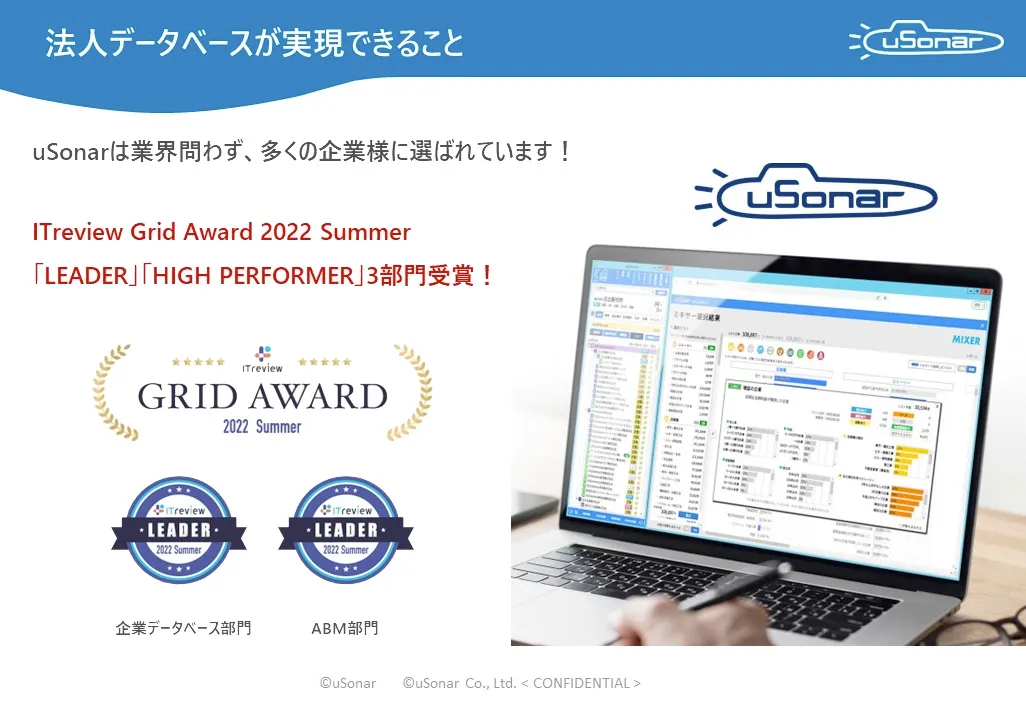
uSonar is utilized by a wide variety of companies
across all industries and sectors.
ITreview Grid Award 2026 Summer
Leader in 6 Categories

With uSonar,
we will guide your company toward solving its challenges!
Case Studies and Sample Reports
Download