- Intent Data
- Digital Marketing
What Is Intent Data? Visualizing Customer Interests Through Behavioral Data

Last Updated: May 15, 2024
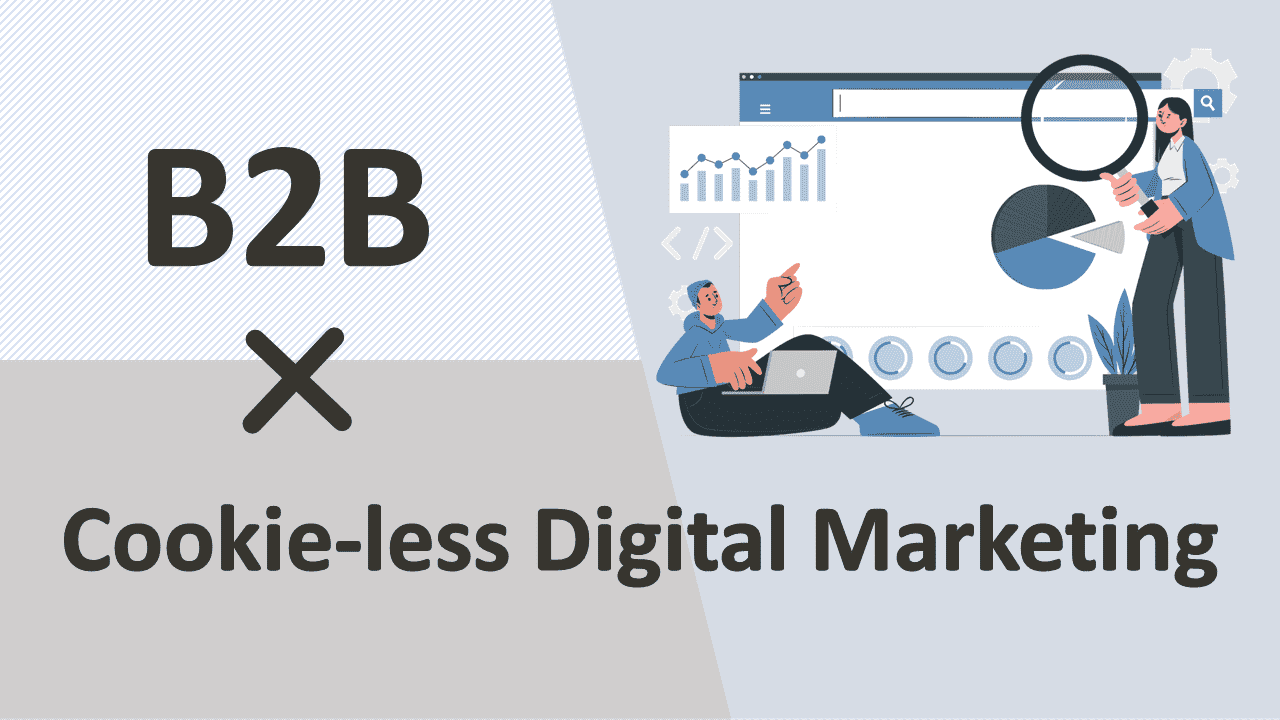
Cookie-based marketing has long played a vital role in digital marketing for both B2C and B2B sectors.
However, in recent years, due to the development of legal regulations and technological advancements, marketing methods that do not rely on cookies have been gaining attention.
This article summarizes the methods and benefits of cookie-based B2B marketing, while also explaining the challenges in their utilization and the new concept of a "cookieless" approach.
Table of Contents
1What Is Cookie-Based B2B Marketing?
2Challenges in Cookie Utilization
2-1Compliance and Adherence to Privacy Regulations
2-3Cookie Lifespan and Accuracy
2-4Deprecation of Third-Party Cookies
3-1Example: Utilizing Non-Cookie Identifiers
3-2Example: Consent Management for Cookie Usage
Recommended Articles

Cookie-based B2B marketing has been considered a strategy for strengthening customer relationships and implementing effective approaches. Examples include the following:
Customize content based on the past behavior and interests of website visitors. For example, present relevant content to visitors who have shown interest in specific products or services.
High-level personalization tailored to individual customers makes it easier to capture their interest, increases engagement within your website, and encourages customer decision-making.
Enhance customer acquisition effectiveness by executing personalized marketing campaigns for key accounts (Account-Based Marketing).
By focusing on targets with deeper insights and displaying advertisements tailored to their specific characteristics, you can reach potential customers who are closer to becoming active prospects.
Beyond maintaining interest when visitors are not on your website, targeted advertising increases click-through rates, reduces wasted advertising spend, and improves ROI.
Furthermore, by visualizing trends in content consumption and search behavior as potential customers become active, you can identify keywords critical to sales activities and explore directions for expanding your company's content.
Execute personalized email campaigns for individual recipients based on cookie data.
Personalized experiences increase customer satisfaction, improve open and click-through rates, and foster continuous communication with customers.
By increasing the probability of visitors returning to your site, you enhance customer engagement and contribute to building long-term customer relationships.
Identifying targets and personalizing experiences using cookies provides value across many aspects of B2B marketing.
While cookie-based B2B marketing is an effective strategy, several challenges and issues have been highlighted in recent years.
As an international trend, the strengthening of privacy regulations such as GDPR and CCPA has introduced strict rules regarding the collection and use of cookie data, making compliance and adherence to legal requirements a significant challenge.
Specifically, there is an increased demand for companies to disclose the reasons (purposes of use) and methods for data collection to users.
Beyond preparing for data breaches caused by cyberattacks, companies are now required to disclose to users the potential risks associated with data collection.
If a company fails to provide sufficient transparency regarding the risks and mitigation strategies in exchange for the convenience provided, it may damage user trust.
Some cookies are deleted after a session ends, making long-term tracking difficult and complicating efforts to build long-term relationships with users.
Furthermore, when information is collected based on cookies across different devices or browsers, data inconsistency can occur, potentially reducing the accuracy of information used to form customer profiles.
Major platform operators, including Google, have signaled the end of third-party cookie support. This has brought significant transformation to the digital advertising industry, necessitating the exploration of new targeting methods.
Companies have begun exploring strategies to provide more valuable customer experiences than ever before, while simultaneously implementing measures for privacy protection and data security.
In digital marketing, there is a growing recognition that an approach that builds trust with users and respects their privacy is the key to success.
Specifically, there is increasing attention on acquiring data that reveals customer insights and context—linked to identifiers other than cookies or first-party data—and utilizing this for message delivery, including advertising.
Overall, while cookie-based B2B marketing remains a powerful strategy, the adoption of cookie-less approaches is gaining attention as a way to adapt to new privacy regulations and technological advancements.
Below are several examples of cookie-less B2B digital marketing.
A method of displaying information or advertisements highly relevant to visitors based on the content and keywords on a webpage.
A method of identifying the IP addresses owned by companies rather than individuals, linking them to corporate information for analysis and targeting.
A method of collecting email addresses to deploy content and promotions tailored to the interests of customers who have provided consent.
A method of providing personalized content and proposals based on information provided by visitors who have consented to share it on the website.
In conjunction with the above, regardless of whether it is B2C or B2B, an increasing number of companies are implementing Consent Management Platforms (CMP) on their websites to acquire user consent and manage the scope of that consent.
A method of reaching target audiences by leveraging business-oriented social media.
SNS ad targeting does not inherently require cookies, as it is possible to display ads based on the platform's proprietary user data and interests.
A method of providing high-quality, useful content to increase website traffic and build trust with visitors through that content.
As a specific example, an increasing number of companies are utilizing content distribution platforms like note to enhance brand awareness.
These approaches are considered effective methods for maximizing reach to target audiences and enhancing B2B digital marketing results while addressing cookie limitations and user privacy regulations.
Cookie-less B2B digital marketing makes it possible to create opportunities to acquire deeper corporate information and intent data while prioritizing privacy protection.
By utilizing data and methods tailored to your company's situation, it is essential to balance building proper relationships with users and improving targeting accuracy, thereby promoting brand awareness, establishing a competitive advantage, and deepening customer understanding.
We offer cookie-less ad delivery services for advertisers and contextual targeting services using native advertising.
Reference: Ad Delivery Service "ad Sonar"
Additionally, we have recently strengthened our support for digital media, having entered into a partnership to link our LBC, one of Japan's largest corporate databases, with the private DMP "piano dmp" via server-to-server integration (details here).
Please feel free to contact us.
About the Author

uSonar Editorial Department
MX Group, Editor-in-Chief
We are the uSonar Editorial Department.
We provide information on data utilization and digital technology useful for considering future business operations, primarily for companies engaged in B2B business.
uSonar is utilized by a wide range of companies across various industries and sectors.
ITreview Grid Award 2026 Summer
Leader in 6 Categories

With uSonar,
we can guide your company toward solving its challenges!
Case Studies and Sample Reports
Download