- CRM/SFA/MA
What Is Marketing Automation (MA)? Explaining Basic Functions, Implementation Methods, and Keys to Success!
Last Updated: July 19, 2023
Click Here to Learn More About SFA and MA ▶
Five Key Points for MA Utilization
What Is the "Truth" That Tool Vendors Won't Tell You?
With the evolution of digital marketing, the perception that manual marketing activities are inefficient is becoming widespread. Marketing Automation (MA) has emerged as a solution to this challenge. What functions does MA offer, and how does it contribute to a company's marketing activities?
While there are various MA products on the market, their core functions are common. This article provides a detailed explanation of the five representative functions of MA. We invite marketing professionals at companies considering MA implementation, as well as those who have already implemented MA and wish to expand its utility, to read on.
Table of Contents
1What Is Marketing Automation (MA)?
2Reasons for Implementing MA and Its Benefits
2-1Streamlining Marketing Activities
3Five Key Functions of MA and Their Use Cases
3-1Customer Segmentation Function
3-2Email Marketing Automation Function
3-4Multi-Channel Campaign Management
Recommended Articles
What Is Marketing Automation (MA)? Explaining Basic Functions, Implementation Methods, and Keys to Success!

Seminar Report:
Three kintone × uSonar Users Share Their Experiences
Revealing Practical Examples of Operational Efficiency and Sales Reform!
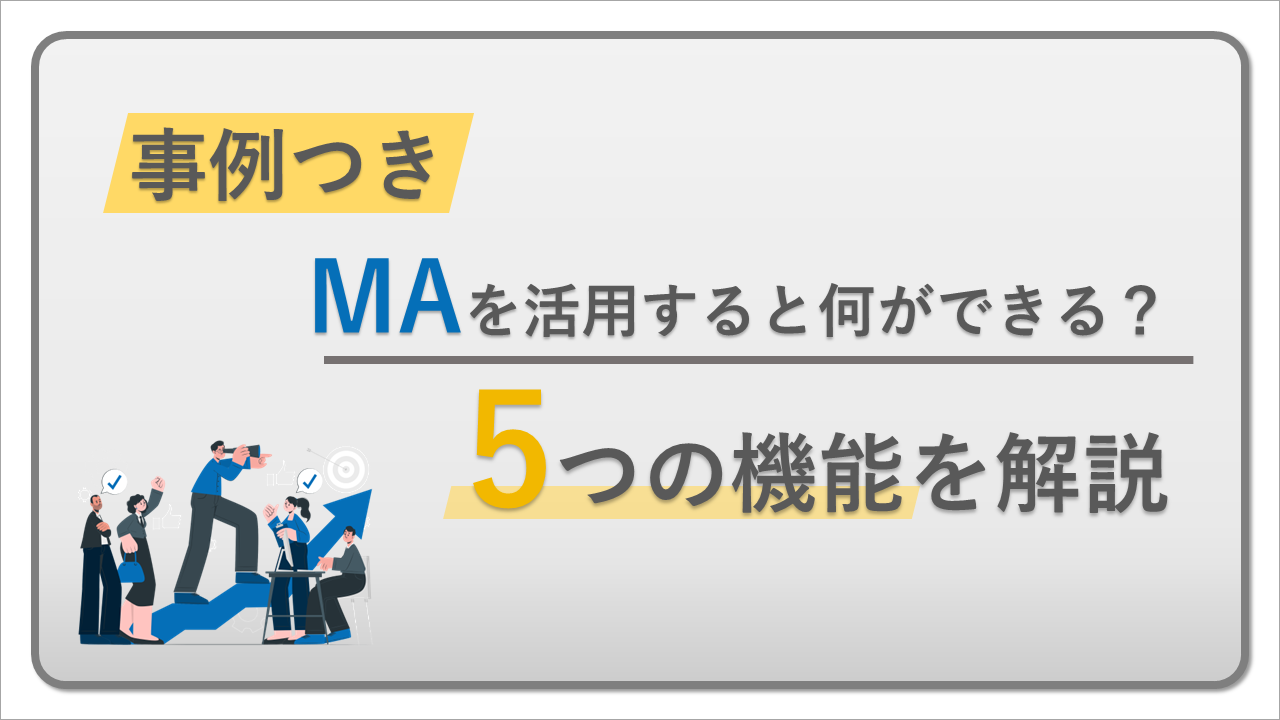
Marketing Automation (MA) refers to a suite of tools designed to automate and streamline a company's marketing activities. It enables centralized management of everything from lead generation and nurturing to customer management, campaign planning, execution, and performance analysis.
The primary feature of MA is its ability to use tools to automate marketing tasks, thereby reducing manual labor while simultaneously providing personalized messages to individual customers. By implementing MA, companies can conduct more efficient and effective marketing, resulting in numerous benefits such as improved customer satisfaction, higher lead quality, and cost reduction.
Furthermore, compared to manual management, MA allows for the centralized management and real-time analysis of large volumes of data. This enables companies to consistently conduct marketing activities based on highly accurate customer data.
In the modern era, customer needs and behavioral patterns are highly diverse and complex. With the widespread adoption of the internet, the scope of marketing activities continues to expand, and managing them has become increasingly complex. In this environment, companies must implement sophisticated management to provide the right message to the right customer at the right time.
To address this situation, traditional manual tasks and management methods have reached their limits. Therefore, the implementation of MA to automate marketing activities has become essential.
While the benefits of implementing MA are wide-ranging, the primary ones are as follows:
Using MA, you can automate repetitive tasks such as email distribution and social media posting. This allows marketing personnel to focus on higher-level strategy development and creative work.
MA manages large volumes of customer data, enabling personalized communication tailored to each customer. This improves customer satisfaction and enhances the quality of leads.
Through centralized data management and analysis features, MA allows you to accurately grasp the results of each marketing activity. By correctly understanding these results, you can make optimal investment decisions regarding where to allocate costs and resources. This makes it possible to improve the ROI (Return on Investment) of your marketing efforts.
Let's take a look at the specific functions available.
This function groups customers based on specific characteristics or behaviors. For example, you can segment customers based on past purchase history, age, region, or website behavior, and provide the most suitable marketing activities for each. This function enables the delivery of personalized messages, realizing effective communication.
<Use Case>
One example of customer segmentation is the "Lifestyle Segmentation" practiced by some retail companies.
For instance, a company might use MA to analyze customer data, identifying customer groups with various lifestyles based on purchase history, interests, hobbies, and social media posts. These segments might include "Outdoor Enthusiasts" or "Eco-Conscious Consumers."
Next, the company implements personalized marketing activities tailored to each segment. For example, "Outdoor Enthusiasts" are provided with information on new outdoor products or outdoor events. "Eco-Conscious Consumers" are provided with information on products made from environmentally friendly materials or eco-friendly initiatives.
While the above is a B2C example, visualizing the attributes and interests of client companies is also important for B2B companies.
Compared to individual interests, corporate interests are difficult to judge internally, so purchasing data or introducing specialized tools is ideal.
By providing information tailored to the preferences of each segment—such as introducing tools to customers interested in cloud migration or DX, or providing educational content and training support services to those interested in employee training—companies can increase customer engagement and conduct effective communication.
This function automatically sends emails based on specific triggers (e.g., website visits, completion of a purchase). It executes automated email campaigns based on customer behavior and segments.
<Use Case>
A specific example of email marketing automation is the "Abandoned Cart Email" often seen on e-commerce sites.
On e-commerce sites, cases where customers add items to their shopping cart but do not complete the purchase procedure for some reason occur frequently.
By using the email marketing automation function of MA, it becomes possible to automatically send a follow-up email to the customer who abandoned their cart, using the abandonment as a trigger. This allows you to guide customers who intended to purchase but dropped off back to the site, leading to a completed purchase.
This function scores the purchase probability of leads, identifying which leads the sales team should prioritize. For example, leads are scored based on website behavior or email open rates, and the sales team prioritizes those with high scores.
<Use Case>
Companies acquire lead information from website visitors, people who download materials, or webinar participants. These leads do not all have the same purchase probability. Therefore, it is resource-inefficient for the sales team to treat all leads the same way.
This is where the lead scoring function of MA is used to evaluate leads. Evaluation metrics include website behavior, email open and click-through rates, industry, job title, and company size.
Through this scoring, the sales team can prioritize high-score leads, using sales resources efficiently to increase results.
This function centrally manages marketing activities across multiple channels, such as email, social media, and the web. This allows for consistent activities even for customers across different channels, and enables advanced cross-channel analysis.
<Use Case>
Suppose a company is planning a campaign for a new product launch that spans multiple channels, including social media posts, email announcements, a special website page, and even in-store POP displays and sampling.
By utilizing the multi-channel campaign management function of MA, you can centrally grasp the status and response of campaigns across each channel, making it possible to deliver a consistent message to customers.
Furthermore, by conducting cross-channel effectiveness analysis, you can understand the effectiveness of each channel and customer behavior across channels. This allows you to discover effective ways to utilize each channel and optimize your marketing activities.
This function analyzes the effectiveness of various marketing activities and formulates improvement measures. By analyzing the results of marketing activities in detail, you can understand what succeeded and what failed. Based on these analysis results, you can formulate effective improvement measures and optimize your marketing activities.
<Use Case>
For example, suppose a company is conducting multiple email campaigns. Here, the reporting and analysis function of MA is used to analyze in detail the open rate, click-through rate, and conversion rate (the achievement rate for target actions such as purchases or downloads) of each campaign.
This allows you to understand which campaign performed best, which email content received the best response, and how the transmission time and day of the week influenced the response, which can then be applied to future distributions.
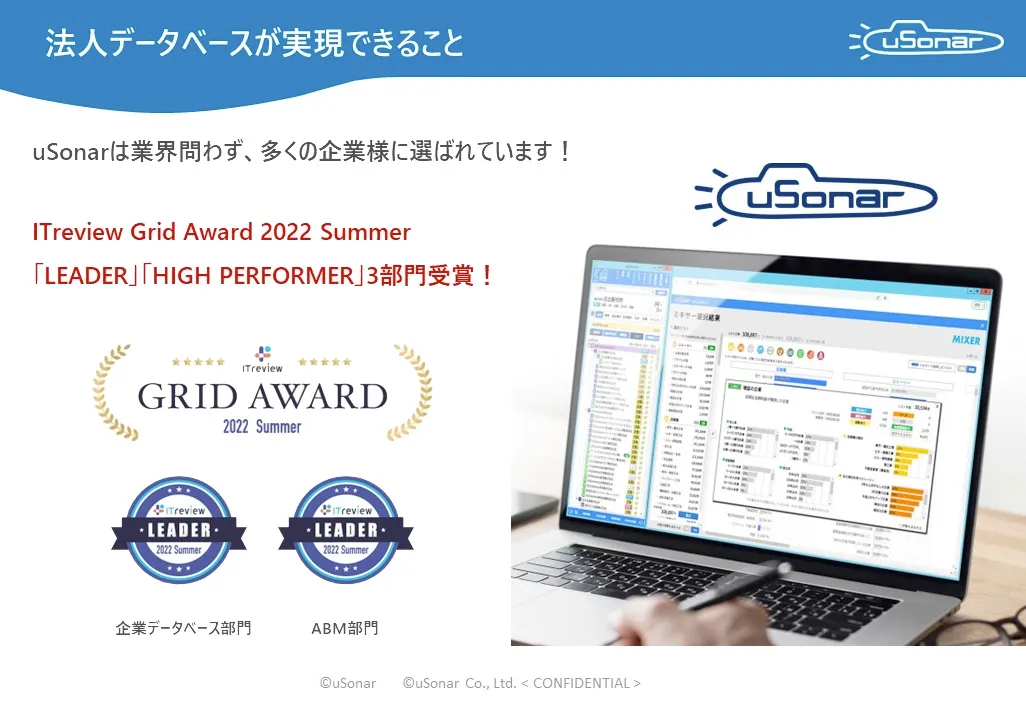
By integrating MA with the corporate data tool uSonar, it is possible to maximize the effectiveness of MA implementation.
• Standardizing Fragmented Operations
• Building an Integrated System to Centralize Customer Information
• Extensive Track Record of Integration with Salesforce
• Unparalleled Quality and Volume of Data, Covering Even Branch Offices and Business Sites
• New Business Negotiations Increased by 120%
• Direct Mail Response Rate Doubled
• Cross-Departmental Utilization, Including Accounting and General Affairs, Has Become Established
For more details on the case study, click here
Recommended Articles:
In this article, we introduced the five main functions of Marketing Automation (MA) and provided specific examples of how to utilize them.
To maximize the effectiveness of Marketing Automation, the richness of your segmentation axes is essential.
Furthermore, it is necessary not only to implement the system but also to ensure proper understanding and operation. Why not start by familiarizing yourself with the key features?
About the Author

uSonar Editorial Department
MX Group, Editor-in-Chief
We are the uSonar Editorial Department.
We provide information on data utilization and digital technologies useful for rethinking business operations, primarily for companies engaged in B2B business.
uSonar is utilized by a wide range of companies across various industries and sectors.
ITreview Grid Award 2026 Summer
Leader in 6 Categories

With uSonar,
we can guide your company toward solving its challenges!
Case Studies and Sample Reports
Download