- Data Utilization
- Sales Strategy
What Is Sales DX? A Thorough Explanation of Its 5 Benefits, Importance, and Keys to Success!

Updated: January 18, 2024

Click Here to Learn More About Business Card Management ▶
Explained by a Database Company:
What Is Business Card Management That Drives Sales Results?
How do you currently manage the business cards that accumulate during your daily sales activities? Many professionals continue using the same management method they adopted when they first joined their company, but there are actually various ways to handle business cards. In this article, we explain both analog and digital management methods, along with their respective pros and cons, and introduce effective strategies for leveraging business card management to improve sales performance.
Table of Contents
1Analog Business Card Management Methods
1-3Rolodex (Rotary Business Card Holder)
2Digital Business Card Management Methods
2-1Scanning Business Cards and Managing via PDF
2-2Compiling Business Cards into an Excel List
2-3Utilizing a Business Card Management System
3Benefits of Analog Business Card Management
4Drawbacks of Analog Business Card Management
4-1Inability to Share Business Card Information Within a Team
4-2Inability to Leverage Business Card Information for Sales Activities
4-3Restricted Access When Working Remotely
4-4Risk of Losing Business Cards
5Benefits of Digital Business Card Management
5-1Ability to Share Business Card Information Across Teams
5-2Elimination of Siloed Sales Activities
5-3Efficient Management of Business Card Information
5-4Access to All Business Card Information While Working Remotely
5-5Business Card Management That Drives Sales Results
6Drawbacks of Digital Business Card Management
Recommended Articles
This method involves filing business cards using a dedicated holder. You can organize cards alphabetically or by other criteria. Since you simply insert the cards into the holder, filing is easy; however, it is generally recommended to insert only one card per slot. If you need to reorder the cards, you must do so manually.
Similar to holder files, this method involves storing cards in alphabetical order. Dedicated index cards are included, allowing you to access the necessary business cards easily. While these can be stored in small desk drawers or kept on top of a desk, they are not suitable for portability. To check the details written on a card, you must remove them one by one.
A Rolodex allows you to access the necessary business card by rotating the stored cards. You can view the contents of the cards without removing them from the holder. Because these are designed to be kept on a desk, it is difficult to store them in a drawer when not in use. You may need to carry a separate card case or make copies of the cards if you need to take them with you.
This method involves scanning business cards and managing them as PDF files. By saving the digitized cards in a shared folder or a designated location within groupware, the sales team can share the data. If the scanned data cannot be uploaded directly to a shared location, you must manually move the files to the shared folder.
This method involves entering business card information into an Excel spreadsheet. Creating a list improves visibility and allows for data sharing. While it enables searching for information, the manual entry process can lead to input errors or duplicate entries, which may hinder searchability.
Today, there are various business card management systems available. For digital management, implementing a dedicated system is the most efficient approach. You can capture card information using a smartphone camera and share it with the sales team. While some free options exist to help reduce costs, they often come with limitations regarding security and convenience. Since there can be variations in reading accuracy during camera capture, it is advisable to consider implementing a paid business card management system from the start.

The benefit of managing business cards in an analog, paper-based format is that it allows for intuitive operation, as anyone can physically handle and organize the cards. If you have relied solely on analog methods for years, you may feel more comfortable with this approach. However, by using a business card management system with simple operations and a clean interface, you can achieve the same intuitive experience with digital management.
When sales representatives manage their own business cards individually, sharing information across the team becomes difficult. Furthermore, if the team has not established rules for post-receipt management, cards are stored in different locations by each employee, making it hard to access the information you need.
When business cards are kept in paper format and managed individually, their utility is limited. They often serve only as a reference for sales representatives to recall names or check contact information for people they have met in the past.
With analog management, the business cards you can check while away from the office are limited. It is difficult to carry all your cards at all times, meaning you may have to wait until you return to the office to access a specific card. This can lead to missed sales opportunities in fast-paced situations.
With paper-based management, you must physically retrieve the card or hand it over to other team members, which increases the risk of loss. Cards left temporarily on a desk to be filed later are also easily misplaced. In the event that a collection of cards is lost while on the go, it can lead to a serious information leak.
Digitizing business cards allows the sales team to share information effectively. Using software that tracks key contact details, addresses, meeting dates, and discussion notes supports collaborative sales efforts. Furthermore, if other departments, such as manufacturing, have access to this information, it can help accelerate ongoing projects.
When customer information is held only by individual sales representatives—a state known as "siloed" or "person-dependent" sales—it narrows the scope of proposals and activities, leading to missed revenue opportunities. Sharing business card information across the team eliminates these silos and expands opportunities for new business. It also facilitates smooth customer handovers, ensuring that customers receive consistent support even when a representative is unexpectedly absent, which enhances customer trust.
While analog management requires manual effort to reorder cards, digital management makes sorting and searching easy. Paper-based filing is often limited to alphabetical sorting, but digital systems allow for instant viewing of information categorized by industry or job function.
By using a business card management system that allows for easy viewing via smartphone, you can access the necessary information immediately, even when you are away from the office.
Some business card management systems integrate with SFA tools. When used in conjunction with an existing SFA, it becomes easier to centralize customer information, thereby improving sales efficiency. This streamlines the process of tracking leads and providing appropriate follow-ups, enabling optimal responses to prospective customers and driving revenue growth. By visualizing project progress, meeting details, and activity history linked to business card information, you can directly contribute to improved sales performance.
For companies introducing digital business card management for the first time, the implementation process may not be straightforward, and it may take time for the practice to become established within the company. It is important to consider adopting a user-friendly system and to foster team-wide understanding regarding why digital management is essential for increasing sales efficiency.
mSonar can be integrated with your currently operational SFA. By fully leveraging contact information from business cards, you will never miss a sales opportunity. With high-precision OCR and manual data verification, business card digitization is highly accurate. Corporate information is registered based on the integrated corporate database, ensuring a smooth process without the risk of input errors. Features such as data cleansing and deduplication ensure that information is constantly updated, eliminating concerns about outdated data or duplicate registrations. Registration is simple, requiring only a photo taken from a smartphone, and the system supports simultaneous registration of multiple cards. By utilizing information from the corporate database, you can visualize untapped target companies, enabling more efficient sales activities.
☆-☆-☆ Body End ☆-☆-☆To convert business cards—which are valuable customer data—into sales results, digital management using a business card management system is essential. Consider implementing a business card management system to streamline your sales activities and strengthen team collaboration.
About the Author

uSonar Editorial Department
MX Group, Editor-in-Chief
We are the uSonar Editorial Department.
We provide information on data utilization and digital technology useful for considering future business operations, primarily for companies engaged in B2B business.
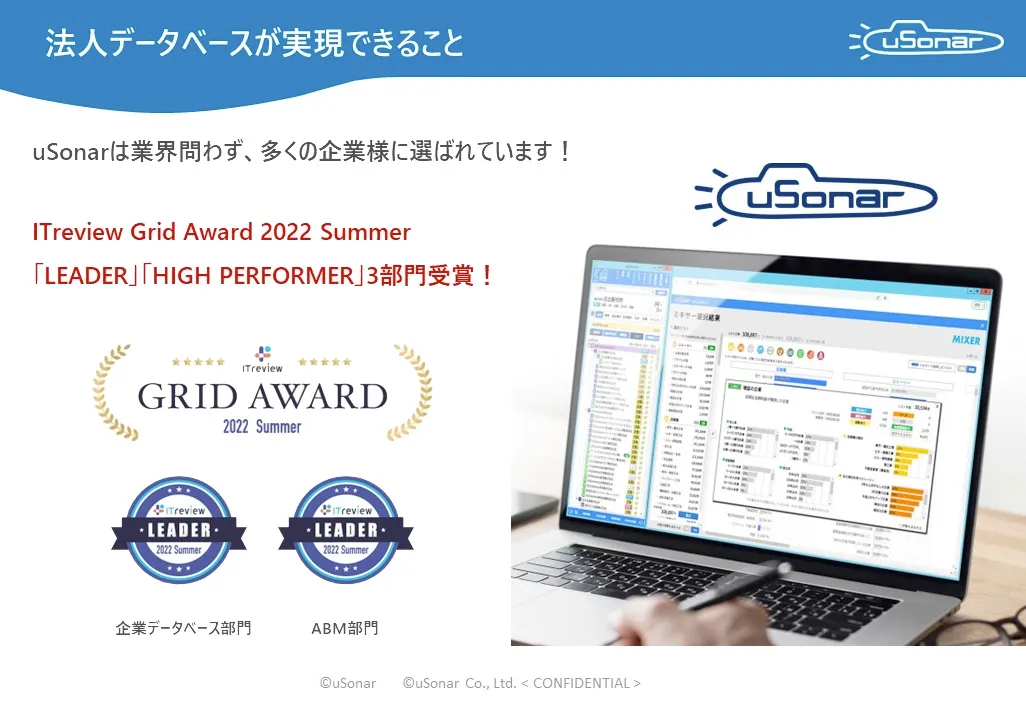
uSonar is utilized by various companies
across all industries and sectors.
ITreview Grid Award 2026 Summer
Leader in 6 Categories

With uSonar,
we can help solve your company's challenges!
Case Studies and Sample Reports
Download