





- Invoice
[Understand in 5 Minutes] How to Search for Invoice System Registration Numbers and What You Can Verify
Use Cases by Objective
New Approach List
Group Strategy

Digital
Marketing

Client Information Registration

Data Cleansing
Corporate Attribute Analysis

SFA/MA Activation

Business Card Data Integration

Credit & Client Screening

Use Cases by Department
Sales Department

Inside Sales
Department

Marketing &
Corporate Planning Department

Information Systems Department

Management Department

Use Cases by Tool
Meeting Sonar
Last Updated: April 26, 2024
Click Here to Learn More About the Invoice System ▶
[Practical Guide] Explaining the Steps to Maximize the Benefits of the Invoice System!
Are you putting off addressing the following challenges related to invoice compliance?
We share expertise gained from building our own corporate database of 8.2 million locations, along with exclusive insights on data maintenance that you won't find anywhere else.
Introducing a guide you can start using today. Download it now for free! Download!
 ☆-☆-☆ Internal Link Button Start ☆-☆-☆ Download Free eBook ☆-☆-☆ Internal Link Button End ☆-☆-☆ Guide to eBook Ends Here
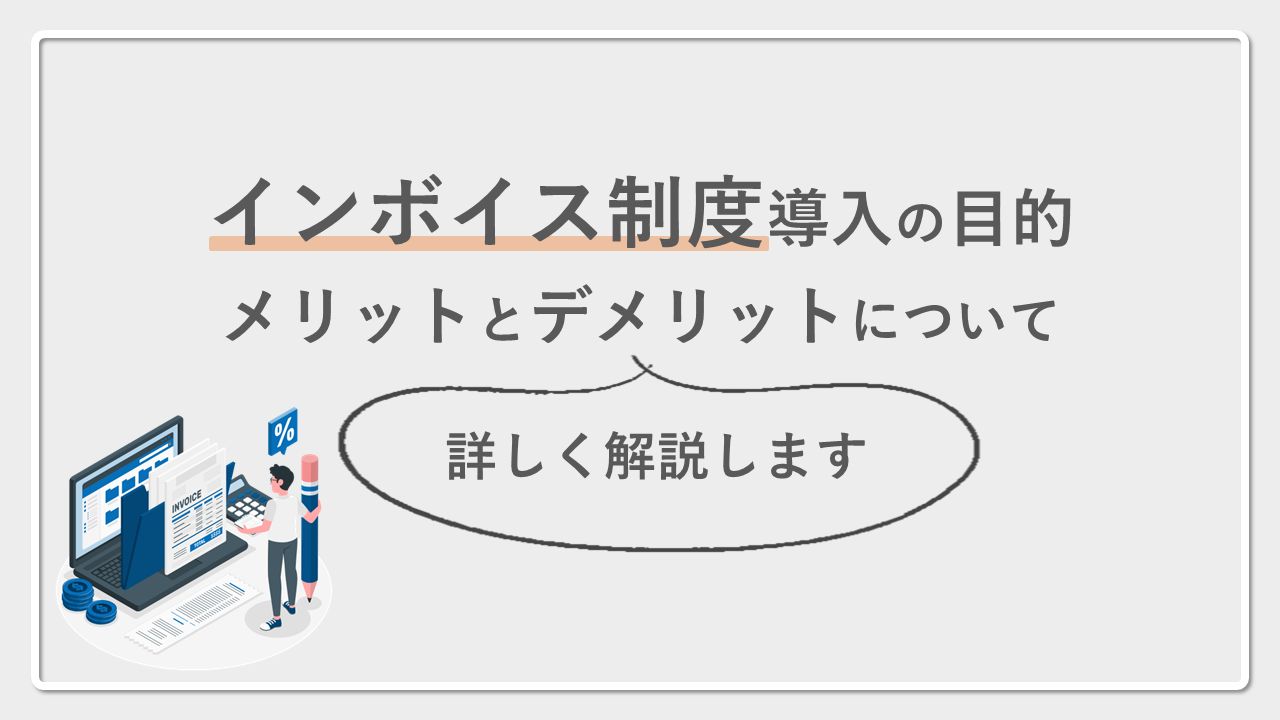
The Invoice System was implemented on October 1, 2023. To qualify for purchase tax credits, businesses must now record and retain additional items beyond those required for conventional itemized invoices. Failure to correctly understand the Invoice System can significantly impact your tax payments and your business partners. In this article, we provide a detailed explanation of the background, benefits, and drawbacks of the Invoice System.
Table of Contents
1Differences Between Taxable and Tax-Exempt Businesses
2Purpose and Background of the Invoice System
3Benefits of the Invoice System
3-1Accurate Recording of Reduced Tax Rates
4Drawbacks of the Invoice System
4-1Potential Increase in Workload Due to Changes in Invoice Formats
4-2Risk of Inability to Claim Consumption Tax Deductions Without Proper Vendor Selection
4-3Difficulty in Verifying Accurate Registration Numbers
5Transitional Measures for Invoices
5-1Six-Year Transitional Period
5-2Withdrawal of Registration as an Invoice Issuer
6Raising Awareness Regarding the Invoice System
Recommended Articles
First, businesses in Japan are divided into two categories: taxable businesses and tax-exempt businesses. A taxable business is defined as one whose taxable sales for the base period exceed 10 million yen. On the other hand, a tax-exempt business is one with taxable sales of 10 million yen or less, referring to businesses that are exempt from the obligation to pay consumption tax.
While tax-exempt businesses are significantly affected, taxable businesses also need to make preparations, such as establishing internal policies and notifying business partners.
The background of the introduction of the invoice system dates back to April 1989, when consumption tax was first established. At that time, due to public opposition, a tax-exempt business system was adopted, which exempted certain small-scale businesses from the obligation to pay taxes. This exempted tax is known as "profit tax."
Starting October 1, 2023, the primary purpose of the invoice system is to eliminate this "profit tax" by requiring businesses to pay the consumption tax collected from consumers to the government rather than retaining it as profit.
In October 2019, the consumption tax rate was increased to 10%, and a reduced tax rate of 8% was introduced for certain items such as daily necessities and food and beverages. With the invoices currently in use, different consumption tax rates are mixed, requiring recalculation for each individual product category.
By introducing the invoice (qualified invoice) system, companies can accurately record the consumption tax amount and consumption tax rate, thereby achieving operational simplification.
The invoice system is effective in preventing tax fraud. With the introduction of reduced tax rates accompanying consumption tax hikes, certain items such as food are set at 8%. In some cases, fraudulent activities occur where items subject to a 10% consumption tax are incorrectly recorded as 8% to gain profit.
The introduction of the invoice (qualified invoice) system provides the benefit of significantly reducing fraud, as the consumption tax amount is clearly stated for each transaction item.
For business entities, a reduction in fraud by suppliers may potentially lower their own tax burden.
The introduction of the invoice system promotes the digitalization of business transactions, eliminating the need for traditional invoice printing and mailing tasks, which significantly improves operational efficiency.
After the introduction of the invoice system, companies will be unable to receive tax credits unless they switch to the required qualified invoices. It is necessary to add the registration number of the qualified invoice issuer, the applicable tax rate, and the consumption tax amount categorized by tax rate to the conventional itemized invoices.
While it is not necessary to create a new format from scratch, as one can simply add the invoice items to the current itemized invoices, a preparation period is required.
If a business partner is a tax-exempt entity, they cannot issue an invoice (qualified invoice), which means you will be unable to receive purchase tax credits.
While it would be ideal if business partners switched to becoming qualified invoice issuers, this is not always guaranteed; therefore, careful judgment will be required in the selection of business partners moving forward.
To select business partners effectively, it is necessary to organize customer data and assign the correct invoice numbers. It can be said that the launch of the invoice system has increased the necessity of customer management.
Click here for information regarding the assignment of invoice registration numbers to customer data.
Regarding invoice registration numbers, while a list of qualified invoice issuers is published, variations in the notation of names and addresses can make it difficult to link published information with internal customer data. Developing a method to reconcile these variations is extremely challenging. If manual verification is ultimately required, the workload becomes immense.
It is particularly difficult to accurately identify registration numbers when a single corporation holds multiple registration numbers or when registration numbers are held at the office level.
If your company has many transactions with small and medium-sized enterprises or at the office level, introducing tools or services specialized in data maintenance may be a realistic solution.
[2024 Edition] Assigning Invoice System Registration Numbers Using Business Establishment Data
Although the Invoice System was implemented on October 1, 2023, transitional measures exist that allow tax-exempt businesses to defer becoming qualified invoice issuers.
There is a six-year transitional period, meaning businesses were not required to become qualified invoice issuers by October 1, 2023.
As shown above, an 80% deduction is allowed for the first three years, followed by a 50% deduction for the subsequent three years. These transitional measures allow businesses to consider whether to become taxable entities until September 30, 2029.
In other words, tax-exempt businesses do not need to rush to become qualified invoice issuers by October 1, 2023, and can evaluate their status during the aforementioned period.
Procurement managers should verify the registration numbers of their business partners within this timeframe.
Qualified invoice issuers can revoke their registration effective from the first day of a taxable period by submitting a "Notification of Registration Revocation" to the tax office.
This means that even if a tax-exempt business registers as an invoice issuer, it can subsequently withdraw that registration.
However, after October 1, 2023, the earliest period for which a withdrawal can take effect is the following year (or the following fiscal year for corporations). Additionally, there are regulatory requirements, such as the need to submit the "Notification of Registration Revocation" at least 30 days in advance.
For procurement managers, it may be prudent to re-verify the invoice registration status of suppliers shortly before October 1, even if they have been checked previously.
Awareness of the Invoice System is necessary not only for the accounting department but for all employees.
Therefore, it is essential to conduct internal training to prevent errors or omissions in invoices and ensure that all staff understand the Invoice System.
Benefits of introducing the Invoice System include improved operational efficiency and fraud prevention. Conversely, a disadvantage is the change in invoice formatting. Furthermore, failure to properly manage business partners may result in disadvantages for your company.
Why not take this opportunity to revisit "internal data maintenance," which you may have been putting off?
uSonar's corporate data LBC can support your transition to the Invoice System. Please check the details in the document below.
Author

uSonar Editorial Department
MX Group, Editor-in-Chief
We are the uSonar Editorial Department.
We provide information on data utilization and digital technology useful for considering future business operations, primarily for companies engaged in B2B business.
uSonar is utilized by a wide range of companies
across various industries and sectors.
ITreview Grid Award 2026 Summer
Leader in 6 Categories

With uSonar,
we can guide your company toward solving its challenges!
Case Studies and Sample Reports
Download