- Customer Management and Analysis
Comprehensive Guide: Introducing Customer Data Analysis Methods! Effective Frameworks and Utilization Strategies

Last Updated: March 27, 2026

In today's rapidly digitizing market, one of the primary management challenges faced by many companies is data utilization. With the "2025 Digital Cliff" warned of by the Ministry of Economy, Trade and Industry now behind us, the promotion of digital transformation (DX) has become an urgent priority across various industries and sectors.
To achieve DX, it is essential to build a logical management structure driven by data. For this, it is critical to determine how to strategically utilize the customer data accumulated through business activities.
Therefore, this article explains methods for collecting, analyzing, and managing customer data, while also introducing specific analytical techniques and practical use cases.
Table of Contents
1Customer Data Utilization Is Essential for Marketing
2Two Types of Customer Data and Collection Methods
2-1Quantitative Data (Information That Can Be Quantified)
2-2Qualitative Data (Non-Quantifiable Information)
3Three Representative Methods for Customer Data Analysis
3-33. Qualitative Information Analysis
4Customer Data Management Methods and Systems
4-1Excel
4-2CRM (Customer Relationship Management)
4-3SFA (Sales Force Automation)
Recommended Articles
Comprehensive Guide: Introducing Customer Data Analysis Methods! Effective Frameworks and Utilization Strategies

Understand in 5 Minutes: What Is Customer Data Management? Explaining the Fundamentals Essential for Analysis and Utilization
In the modern era, technological innovation is accelerating market maturity, leading to the increasing commoditization of products and services. In a market saturated with similar products, where the needs of customers and general consumers are becoming more diverse and sophisticated, it is not easy to differentiate through functional value propositions such as product performance or price. Furthermore, the spread of the internet has added a self-directed information-gathering phase to traditional purchasing behavior. As customer information literacy rises, there is a growing trend, even in B2B business, to place greater importance on value-added services, such as the quality of support from representatives and after-sales service, rather than just the product itself.
Against this social backdrop, for companies to achieve sustainable growth, they must provide unique customer experience value that competitors cannot replicate. To deliver superior customer experience value, a deep understanding of the customer is the most critical challenge, requiring strategic data analysis that accurately captures the latent needs and insights of prospects and consumers. Without a profound understanding of the pain points and service requirements of prospects and existing customers interested in your products, it is impossible to create services that address essential demand.
B2B companies, in particular, must nurture prospects from initial product awareness to contract closure, and the cost of acquiring new customers tends to be higher compared to B2C businesses. Since resources for marketing and sales activities are limited, companies must establish systems to efficiently approach prospects with high conversion potential and loyal customers. This makes the process of deepening customer understanding essential, and the strategic utilization of customer data is indispensable for creating unique customer experience value that sets a company apart from its competitors.
Customer data can be broadly categorized into two types: Quantitative Data, which is aggregated and measured numerically, and Qualitative Data, which is difficult to quantify or categorize. The role of customer data management is to utilize these two types of data according to specific analytical objectives to gain a deeper understanding of customers. This section explains these two types of customer data and their respective collection methods.
Quantitative Data refers to information that can be clearly expressed numerically, such as sales revenue, company size, number of employees, number of business meetings, number of orders, and order values. Other information classified as quantitative data includes customer attributes such as the company, industry, and job title of a prospect, as well as access logs like website search traffic, page views, and bounce rates. Because quantitative data can be aggregated and measured as specific figures, it is easy to process and is utilized as foundational data for research and analysis tasks, including market research, demand trend forecasting, marketing analysis, and customer analysis.
There are various methods for collecting quantitative data. Representative examples include website access analysis, customer information obtained during inquiries, visitor information gathered at events or exhibitions, interviews, surveys, and probability sampling. For instance, by collecting data on conversion rates and search keywords through website access analysis, you can objectively analyze prospect interests and identify issues with your company's website from a bird's-eye view. Additionally, at events and exhibitions, extracting customer attributes from the business cards of acquired prospects can lead to the creation of customer touchpoints and business meeting opportunities.
Qualitative Data refers to linguistic information that cannot be expressed in numbers. It encompasses data that is difficult to quantify and requires psychological judgment, such as satisfaction levels regarding company products or customer service, the purchasing intent prospects hold toward products or services, and impressions of the corporate brand. Furthermore, points of caution during customer interactions, records of troubleshooting or complaint handling, and information regarding key decision-makers also fall under qualitative data. Qualitative data serves as foundational data for analyzing intuitive and emotional factors, such as uncovering latent customer needs, identifying consumer insights, and gauging the purchasing intent of prospects.
Primary methods for collecting qualitative data include inquiries via corporate websites, social media posts, capturing Voice of Customer (VOC) data from contact centers, and conducting customer surveys or member interviews. Qualitative data collected through these channels provides linguistic and emotional insights into prospect sentiments and existing customer perceptions, serving as a vital resource for creating superior customer experiences. While it cannot be compared or verified through numerical quantification like quantitative data, it is utilized in business domains such as sentiment analysis—which cannot be measured by numbers alone—and text mining using natural language processing.

There are various methods for customer data analysis, and it is essential to adopt approaches that are suitable for your company's business model and analytical objectives. Here, we introduce the following four representative customer data analysis methods.
Segmentation Analysis is a component of STP analysis, which integrates Segmentation, Targeting, and Positioning. Specifically, it segments customer information based on various criteria such as industry, company size, corporate culture, decision-making authority, and purchase history of similar products. By analyzing priorities, projected revenue, response measurement results, and the likelihood of conversion from the categorized customer information, it becomes possible to focus your approach on segments with high profit potential.
Pipeline Analysis is an analytical method that organizes your company's sales process in chronological order to facilitate analysis and improvement. A pipeline is a concept representing the sequence of sales activities, referring to the business flow from initial inquiries or meetings to closing a deal. Pipeline Analysis is a method for visualizing bottlenecks by breaking down and collecting data across each process of sales activities, including initial meetings, needs assessment, proposals, quotation presentation, closing, contract finalization, and after-sales support. By analyzing each process of sales activities from a bird's-eye view, it contributes to the optimization of KPIs and KGIs, leading to the establishment of logical, data-driven sales strategies.
Qualitative Information Analysis is an analytical method based on qualitative data that is difficult to quantify or categorize, as mentioned previously. Customer data includes information that cannot be expressed through simple numerical values, such as user psychology and survey responses. Quantitative data cannot capture the voice of the customer or their level of satisfaction; therefore, to grasp latent demand, it is necessary to delve into psychological and emotional information that cannot be quantified. Qualitative Information Analysis is a highly effective method for uncovering underlying sentiments that cannot be read from numbers, helping to identify the challenges of prospective customers and the needs of existing clients. However, since it is prone to subjective evaluation, analysis based on an objective perspective is essential.
To effectively leverage customer data for marketing strategies and sales activities, superior digital solutions are essential. The following four systems are representative examples suitable for managing and operating customer data.
Excel is an excellent software that can be utilized for customer data management, as it is equipped with various functions such as creating and editing tables and graphs, performing calculations using formulas, and processing databases through sorting and extraction. As a basic management method, you can set management items according to customer types, such as corporations or individuals, and input data such as project names, company names, contact persons, contact information, estimated amounts, status of correspondence, and the date of the last visit. By utilizing the table function to process the entered information as a database, you can create a basic customer data management sheet optimized for tasks such as extraction and aggregation.
CRM stands for Customer Relationship Management. While in a broad sense it refers to a management philosophy for optimizing relationships with customers, in recent years, it is commonly used to refer to IT systems that centrally manage customer data. CRM is a solution that allows for the integrated management of data related to customers, such as the status of business negotiations, history of actions, purchase ratios, sales composition ratios, and correspondence history at contact centers. Unlike Excel, it allows for simultaneous editing by multiple users and integration with other tools. Furthermore, because it enables management based on customer stages, it offers the advantage of being easily reflected in marketing strategies and sales activities.
SFA stands for Sales Force Automation, which refers to systems designed to systematize sales activities. It is a solution that comprehensively supports the workflow of sales activities, including centralized management of sales status and revenue, management of sales personnel activities, progress management of business negotiations, and email distribution to customers. While SFA and CRM are solutions with similar functions, the scope of their management differs. CRM is a system for formulating business strategies by sharing and linking customer information across multiple departments, including not only the sales department but also the information systems and marketing departments. On the other hand, SFA is a system aimed at consolidating sales information that tends to become siloed by managing detailed negotiation information with customers involved in projects and deals. By integrating SFA and CRM, companies can aim for further improvements in sales and marketing performance.
MA stands for Marketing Automation, which refers to solutions specialized in the automation and efficiency of marketing activities. It is a system designed to streamline the phases from acquiring customer information to converting them into business opportunities, with the goal of maximizing lead generation and sales opportunities. MA has the characteristic of enabling effectiveness measurement based on both quantitative and qualitative data, allowing for optimized approaches to each individual prospect or existing customer. This streamlines the processes of lead generation, lead nurturing, and lead qualification in B2B marketing, leading to significant productivity improvements through the automation of tasks that were previously performed manually.
As mentioned at the beginning, the realization of DX has become an urgent priority across various fields in the modern era, and the strategic utilization of customer data has become a critical management challenge for many companies. DX is not merely about IT adoption; it is a concept that signifies organizational reform through the use of digital technology. To achieve this, cross-company sharing and integration of customer data through tools such as CRM, SFA, and MA are essential. For example, one systems integrator faced a management challenge where high departmental independence led to inefficient internal information sharing.
Furthermore, the company was unable to fully grasp the areas where its own services had not yet penetrated, and the analysis of such areas required significant man-hours. Additionally, because analysis tasks were performed individually, similar analytical data remained scattered throughout the company. These challenges were overcome by solutions such as the customer data integration tool uSonar and existing SFA systems. Promoting the use of these systems led to seamless information sharing and improved operational efficiency, while identifying white spaces—areas without existing contact—enabled the development of effective strategies. For those who wish to learn more about customer data utilization case studies, please refer to the link below.
In today's world, where market maturation is accelerating, providing unique customer experience value is essential to differentiate from competitors. To create superior customer experience value, it is necessary to analyze what prospective and existing customers are seeking and translate those insights into product development that captures latent demand. This requires the optimization of customer data management, making the use of various analytical methods and solutions indispensable. To promote the realization of DX and establish a management structure suited to the new era, we encourage you to engage in the strategic utilization of customer data.
About the Author

uSonar Editorial Department
MX Group Editor-in-Chief
This is the uSonar Editorial Department.
We provide information on data utilization and digital technologies useful for rethinking future business operations, primarily for companies engaged in B2B business.
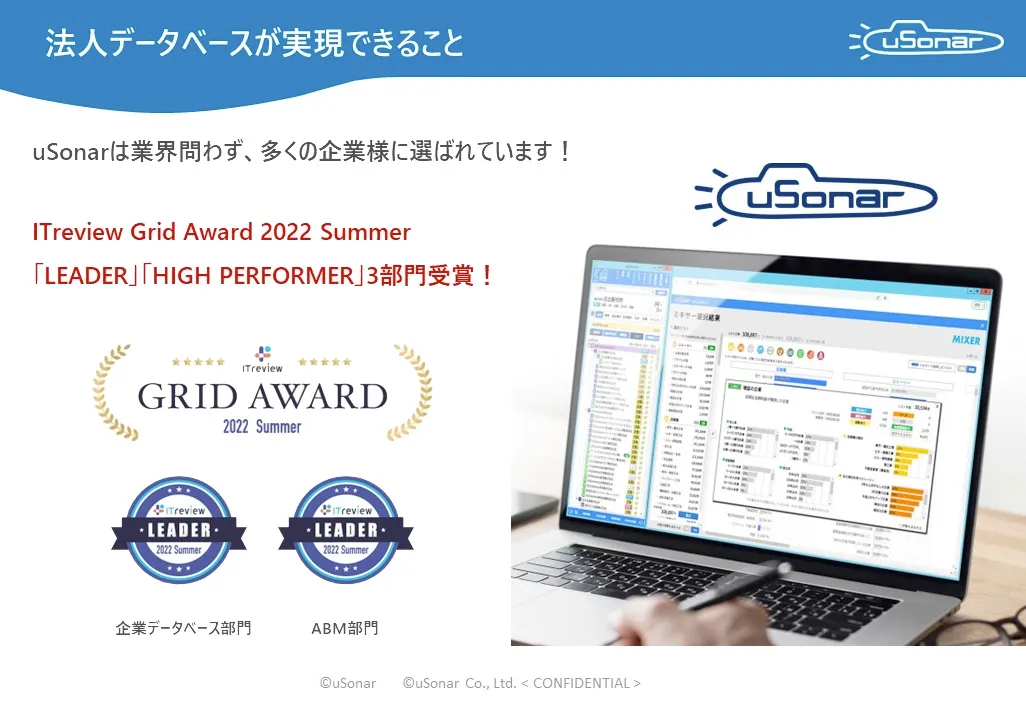
uSonar is utilized by various companies
across all industries and sectors.
ITreview Grid Award 2026 Summer
Leader in 6 Categories

With uSonar,
we can guide your company toward solving its challenges!
Case Studies and Sample Reports
Download