


















Corporate News
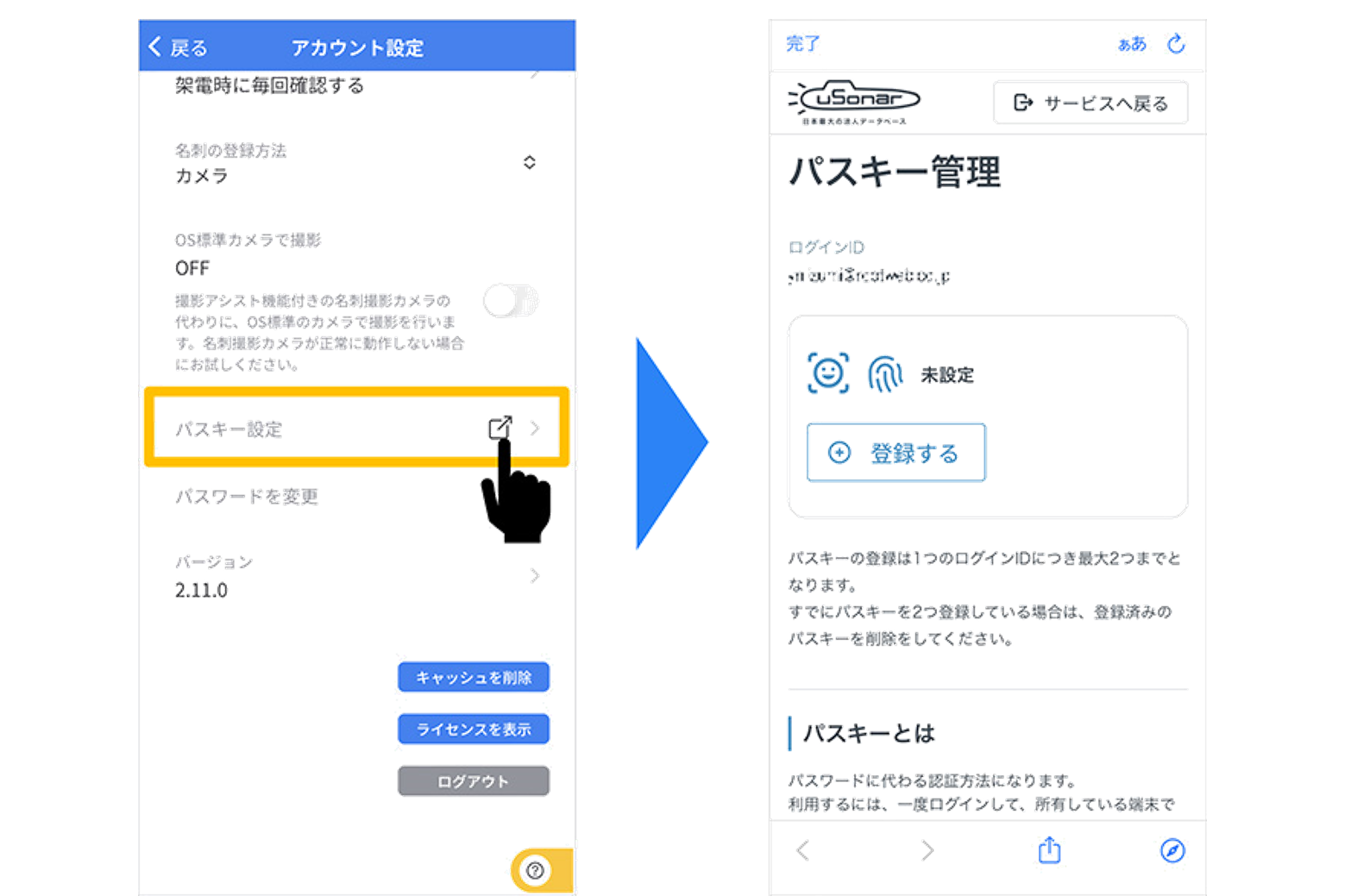
uSonar Co., Ltd. (Headquarters: Shinjuku-ku, Tokyo; Chairman: Nami Fukutomi; President: Katsuhito Nagatake; hereinafter uSonar) is pleased to announce the implementation of "Passkey Authentication," which allows users to log in using biometrics such as fingerprints, into the corporate information and business card management app "mSonar."
This follows a major feature update implemented on the 19th. This is the first time a major business card management service has introduced the passkey method.*
Since last year, there have been successive reports of information leakage incidents in corporate business card management services, believed to be caused by inadequate management of login IDs and passwords (there have been no such cases at uSonar).
Because Passkey Authentication eliminates the need for IDs and passwords, it is expected to reduce the risk of unauthorized access.
*As of September 20, according to uSonar research.
Background of Implementing Passkey Authentication
Regarding business card management services, there have been successive reports since last year of mass exfiltration of sales prospect (customer) information and unauthorized access occurring at the time of employee turnover or resignation. While these are cases involving other companies' services, one of the cited causes was inadequate management of login IDs and passwords.
Since uSonar originated as a provider of large-scale corporate information services, we have maintained a high level of awareness regarding information protection in our design philosophy and have implemented multiple layers of security to prevent leaks. However, operational leakage risks related to login ID/password management by user companies remained.
In Passkey Authentication, the concept of a login ID and password is not required at all. We considered this implementation because it eliminates the administrative burden of managing IDs and passwords for user companies and is expected to reduce the risk of information leakage.
Reference Press Release: https://usonar.co.jp/en/news/20240213_438.html
Overview of Passkey Authentication
Passkey authentication is an authentication method that utilizes a user's unique biometric information, such as fingerprints (thumb touch, etc.) or facial expressions. Many people are likely familiar with biometric authentication, as it is commonly used when unlocking smartphones.
Passkey authentication is a highly secure technology that differs from conventional biometric authentication methods, as the registered biometric information remains within the user's device.
We have already implemented passkey authentication in our business strategy platform, PLANSonar, and this integration into mSonar (GuideSonar) marks our fourth service to adopt this technology.
Features and Content Implemented in mSonar with This Update
• Integration with Nikkei WHO'S WHO, the corporate personnel database by Nikkei Inc.
• Access to summaries and image materials of corporate IR disclosures (financial results)
• Enhanced participant search functionality within the Talk (chat) feature
In addition, a total of 15 new features and content have been added.
About mSonar
mSonar is a corporate information and business card management service equipped with one of Japan's largest corporate databases.
It represents a significant evolution of Meishi Sonar, further expanding the corporate data that uSonar specializes in—including patents, trademarks, and corporate registration information—while strengthening communication features such as chat and internal messaging.
With granular permission management, it is designed for use not only by sales departments but by all departments across an organization. It also features robust business card management capabilities, including AI-powered image capture. It is a service that transcends the traditional concept of business card management tools.
Click Here for Details on mSonar
Contact Information for This Inquiry:
uSonar Co., Ltd. Public Relations (Hiyama/Sawada)
Email: ir@usonar.co.jp