Corporate News
uSonar Co., Ltd. (Headquarters: Shinjuku-ku, Tokyo; Chairman: Nami Fukutomi; President: Katsuhito Nagatake; hereinafter "uSonar") is pleased to announce that it has updated its corporate data items to comply with the "Japan Standard Industrial Classification (notified in July 2023)" enacted by the Ministry of Internal Affairs and Communications in April 2024. Following the Ministry's first revision in 10 years, uSonar has updated its provided data (LBC) accordingly. In addition, uSonar has revised its proprietary "Ryo-Gyoshu" industry classification, which consists of 779 categories tailored to corporate needs. uSonar remains committed to providing data based on both standard industrial classifications and more practical, highly useful industry categories.

What Is the Japan Standard Industrial Classification?
The Japan Standard Industrial Classification was established in 1949. Currently, all domestic industries are categorized into approximately 1455 business sectors. In addition to being used as a standard for official statistics, it influences a wide range of corporate practices, such as the classification and aggregation of business partners.
This is the first revision in approximately 10 years since the previous one in 2013, and the new classification was implemented in April 2024. For more details, please visit the Ministry of Internal Affairs and Communications website.
Ministry of Internal Affairs and Communications Website: https://www.soumu.go.jp/toukei_toukatsu/index/seido/sangyo/R05index.htm
Key Points of the Japan Standard Industrial Classification Revision (Excerpt) and Changes to Our Corporate Codes
We believe this revision reflects changes in socio-economic conditions, such as decarbonization, amendments to the Electricity Business Act, and the COVID-19 pandemic. Below are examples of the main revision points.
- The "Electric Furnace and Electric Heating Equipment Manufacturing" sector has been newly established as a classification item to track decarbonization initiatives and related activities.
- In response to the widespread adoption of 100-yen shops and similar retailers, "Fixed-Price Stores" have been newly established. Previously, these lacked specific examples in the industrial classification and were categorized across multiple sectors.
- Following the amendment of the Electricity Business Act and the full liberalization of electricity retail, the types of electricity businesses have been broadly categorized into "Power Generation," "Power Transmission and Distribution," and "Electricity Retail." Accordingly, "Power Plants" and "Substations" have been divided into "Power Generation Business," "Power Transmission and Distribution Business," "Electricity Retail Business," and "Electricity Wholesale Business."
- Against the backdrop of the COVID-19 pandemic, the "Pest Control Business" has been newly established to track trends as a field of public health.
uSonar's proprietary industry classification, the highly acclaimed "Good Industry" categories, is also available in parallel.
As mentioned above, while the Japan Standard Industrial Classification accurately and precisely categorizes all industries, it has been noted that it contains many "Other" categories, making it difficult to use in practical business applications. Furthermore, because the revision interval is long—approximately every 10 years—it is difficult to classify emerging industries. For this reason, we have long developed and provided our own proprietary industry classification system, "Ryo-Gyoshu." Ryo-Gyoshu consists of 779 industry categories (as of February 1, 2023).
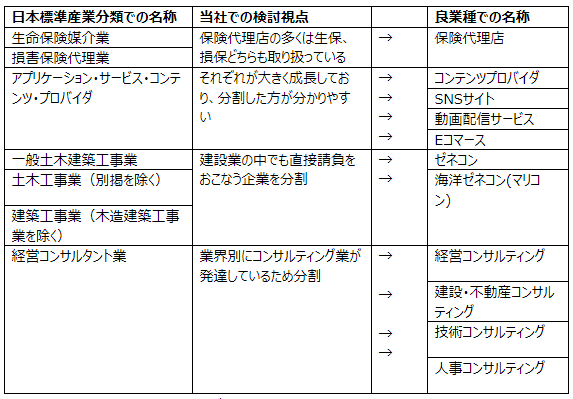
- Consolidating sub-industry classifications that are considered too granular in the Japan Standard Industrial Classification into forms better suited for the business environment.
- Splitting industry categories that are grouped together in the Japan Standard Industrial Classification but are deemed to require segmentation due to rapid growth.
- Ryo-Gyoshu is established by referencing social norms, business environments, news information, industry associations, and business licenses. We flexibly consider consolidation and segmentation as business structures and other factors evolve.