























Setting Effective Priorities for Resource Allocation Through "Defensive CS"
uSonar supports corporate CS and marketing activities by providing the customer integration platform "uSonar," which is equipped with the corporate master database "LBC." Mr. Yuasa of uSonar states, "For CS to maximize LTV, both 'defensive' efforts, such as improving usage and retention rates, and 'offensive' efforts, such as expanding sales, are necessary."
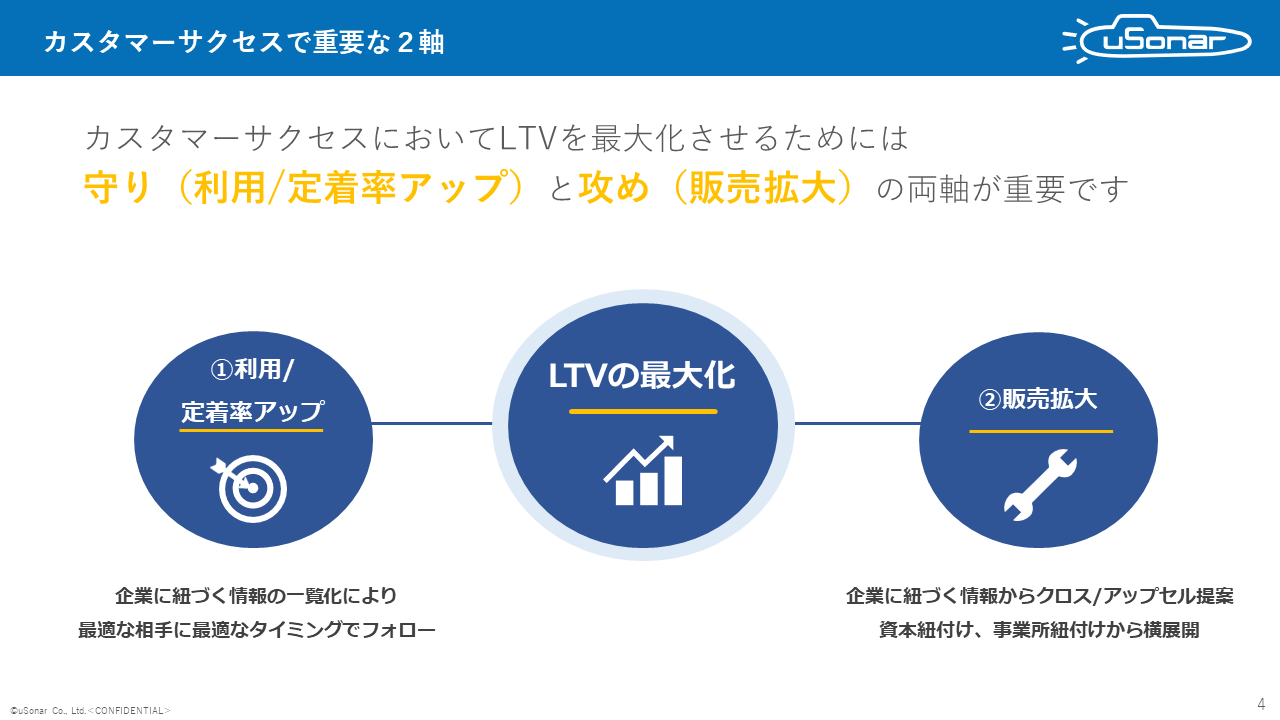
First, regarding defensive strategies, ensuring customer contract renewal is a critical KPI. As uSonar itself provided uSonar to numerous companies, it encountered challenges such as wanting to increase post-implementation retention rates, prevent churn among key accounts, and improve service utilization rates among client companies. Consequently, the company has been strengthening its CS structure and implementing various initiatives since around 2019.
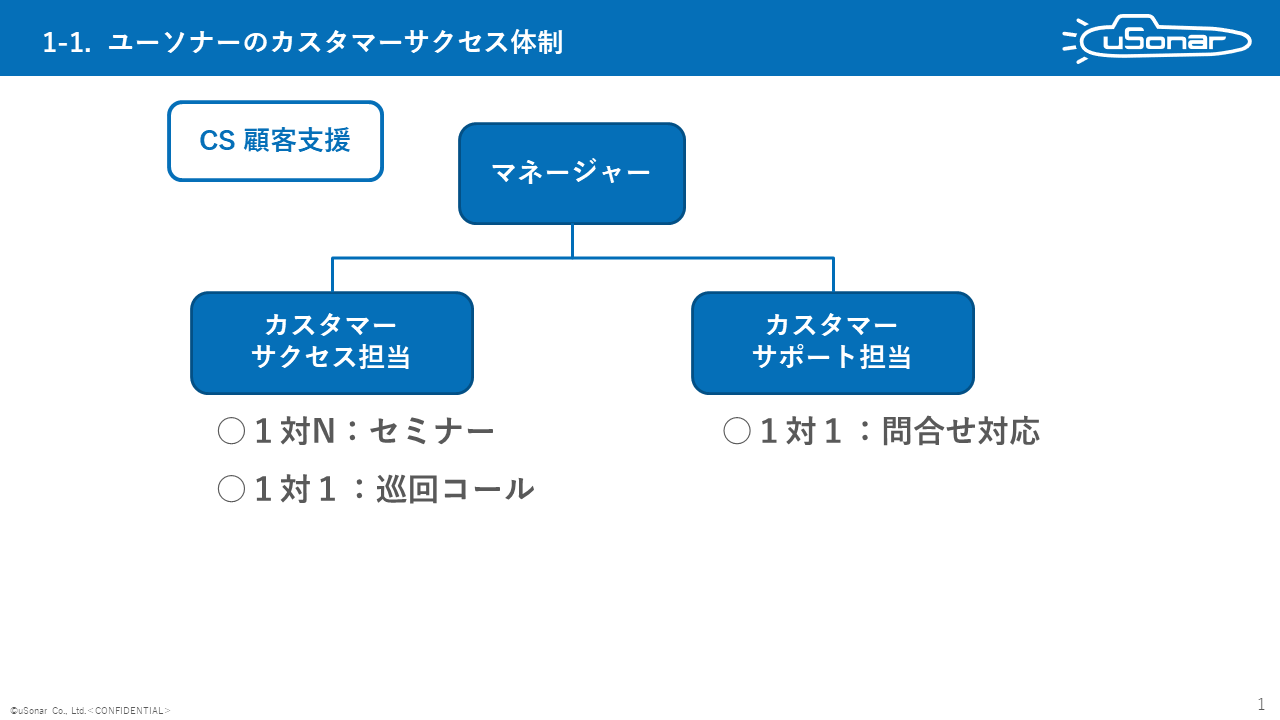
The CS department structure consists of a manager overseeing two units: Customer Success and Customer Support. The former acts as a backup, conducting regular check-in calls with individual companies and hosting periodic one-to-many seminars to introduce new features and encourage usage. Seminars, in particular, are actively held to maintain touchpoints, as they serve as opportunities to identify customer pain points and requests. Meanwhile, the latter, the Customer Support team, focuses primarily on handling inquiries, such as customer questions and troubleshooting.

We conduct regular check-ins even with customers who report no specific issues, following up at least once every three months to uncover potential challenges. Even if there are no issues immediately after implementation, customer needs evolve over time—after a few months, a year, or even two to three years. If we fail to notice these changes and neglect the account, satisfaction may decline, potentially leading to churn, says Mr. Yuasa.
However, resources are not infinite, even when attempting to address all challenges and concerns. To respond efficiently, it is necessary to prioritize follow-up efforts. Therefore, uSonar categorizes clients into a matrix based on company size and annual transaction value to determine the priority for follow-up.
For S-tier customers—high-value clients with extensive usage scope and scale who are achieving business growth alongside our products—we provide top-priority support and follow-up. For A-tier customers—potential clients with large company sizes but limited implementation departments or functions—we actively approach them by sharing case studies and feature introductions, aiming to help them reach the status of S-tier customers.
For B-tier customers—semi-high-value clients with smaller company sizes but high transaction values—we provide follow-up with a focus on avoiding churn risk, while keeping in mind the potential for increased transaction value, such as with high-growth startups. Finally, for C-tier customers—companies with both small company sizes and low transaction values—we do not neglect them but provide as much follow-up as possible depending on the situation.